Boy’s padded kimono with flags
Tsumugi silk, cotton ties, partial cotton and silk lining, waste silk padding
Stenciled warps and wefts

This kimono subtly supports Japan’s early 20th century expansionist policies. The three flags shown are Japan’s national flag (red disc on white ground), its military flag (red disc with red rays), and the flag of what was then the Japanese colony of Manchuria (parallel stripes). The colors are inaccurate, possibly relating to dye shortages occasioned by the military effort.  The extra flap of cloth, sewn down all across the hips, can easily be unstitched, and kept the child from outgrowing the kimono too quickly.


An interesting touch is the maker’s careful alignment of all the flags along the seams. As seen in previous instances, the person sewing the kimono may have little regard for matching or contrasting the designs on the left and right panels. More interesting still is the fact that the maker has taken special care to place the national flag just below the nape of the neck – exactly where the family crest would be on a more formal garment.

Girl’s padded underkimono
Varieties of silk, silk padding
Shibori, stenciling, clamp resist

That the designs are limited to the sleeve edges, collar, and hem indicate that this is an underkimono. These parts are expected to pop out flirtatiously at the sleeve openings, collar and hem of the kimono worn over it. Any additional designs would go unseen. The length of the sleeves indicates that this underkimono was for formal occasions.

This underkimono is comprised of six separate kinds of red silk. The center back is a simple plain weave silk. Below that is a strip of safflower shibori in asanoha (hemp leaf) pattern, and below that, at the hem, is a separate strip, probably stenciled. The large sleeve openings are dyed with clamp resist, the small sleeve openings are safflower shibori, and the sleeves themselves are chirimen – highly twisted silk crepe. The lining is also made of plain weave silk.

Above is a close up of the hem. From a distance, the hem looks like a single material, but close up the difference is easier to see.

Safflower was once an extremely expensive dye, and red was an extremely popular color, so dyers also used madder, among other sources, when red was called for. Safflower is also a fugitive dye, and can lose color in a telltale manner. The horizontal yellow strip on the left in the photo above shows safflower dye that has lost color.

The lightweight padding inserted between the outer and inner layers indicates winter wear.

???????????????????????????????

Length of cloth from a bolt
Cotton
Printed

This contemporary length of cloth refers to the legend of the White Rabbit of Inaba, first recorded in the Kojiki over a thousand years ago. Rabbit motifs are still very popular in Japan. The designer of this material capitalized on that popularity. This design draws heavily from tradition, evoking tsutsugaki festival designs of the Edo and Meiji periods. It is updated for modern tastes, and reproduced on a soft but durable cotton that can stand up to regular use.

Fragment with family crest
Tsumugi silk
Hikizome (brush dyeing)

Four feet long and two panels wide, cut off at both the top and the bottom, the original purpose of this textile is not clear, although the late Tomoyuki Yamanobe, Curator Emeritus of the Textile Department at The Tokyo National Museum, pointed out that the material even when new would have been too fragile for outdoor use.

According to John Dower in The Elements of Japanese Design, the omodaka, or water plantain, dates back as early as the Heian period in design, and became a popular choice for the family crest during the feudal period. Dower suggests that one of its alternative names, shogunso, or victory plant, may explain its popularity among the military elite.

Above, it can be seen that the wefts are made of large cottony raw silk (tsumugi), while the warps are of very fine silk. (Double click to enlarge.) Also shown is a spot where the dye bled. The dyestuff is probably sumi ink.

Above, the face and reverse are shown together. The face is several shades darker. In this piece, the dye was brushed on (hikizome), so the reverse side received less dye and is lighter.

Hitoe, detail
Silk, cotton (?)
Kinu koubai

The close-up shown above is approximately half an inch square. Kinu koubai is a weave said to use silk as its primary material, with cotton interspersed at regular intervals to form a grid in the warps and wefts, as seen above. This makes a lightweight, airy fabric.

From a distance, the grid nearly disappears, as below.

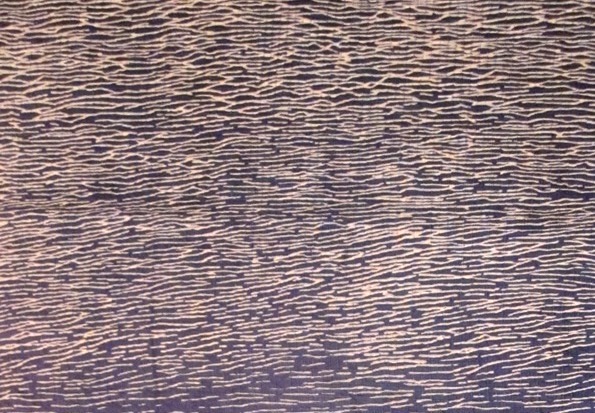
The blue and white design looks very much as though it was inspired by Hokusai’s famous woodblock print entitled Red Fuji.

The textile designer made a major change, however, and turned the clouds 90 degrees, so they become long vertical dashes. Note that the deep blue down the center seam of the hitoe shown below is not a trick of the light. Just as in Hokusai’s Red Fuji, where the clouds thin out and show the blue sky, at the center seam the ‘clouds’ also thin out and deepen the ground color.

Hitoe
Silk
Stenciled warps, hand tie-dyed wefts

The design of whirlpools and ships with billowing waves on this unlined summer kimono would have evoked cool breezes during the hot summer weather. The long sleeves place this piece in the early twentieth century. The whirlpool motif also enjoyed great popularity during the early twentieth century.

Kimono
Silk, cotton (lining)
Stenciled warps and wefts (meisen); additional technique (?)

This kimono shows cubist influence.

The dyeing technique appears to be primarily stenciled warps and wefts, but in some areas color appears to have been added after the weaving process. In the photo below, the pink area does not show the rigidly defined warps and wefts characteristic of patterns dyed before the weaving process.  Anyone with information to support this idea (or information to contradict it) is encouraged to write in.

Compare the sharp, irregular angles in the kimono pattern to the cubist painting of the Eiffel Tower by Robert Delaunay, below.

As noted earlier this week, The Los Angeles County Museum of Art showed a number of early 20th century kimono in 2015, in an exhibition entitled Kimono for a Modern Age.  For the LACMA website, click here.  For an article on the LACMA exhibition, with a series of photographs, click here.

Wedding futon cover
Cotton (home spun)
Rice paste resist, dyes, pigments

The motif of the lion and peony is taken from the auspicious Noh play Shakkyo (Stone Bridge). The lion is viewed as masculine, the peony as feminine, appropriate for an item in a wedding trousseau.

Many futons are three and four panels wide. Five panel futons, such as this one, are less common, requiring more work and more coordination of the design from panel to panel during the creation process.

A similar futon cover, said to have been made in Kyushu, the southernmost of the central islands, is in the collection of the Honolulu Academy of Arts, and shown in Reiko Mochinaga Brandon’s informative book, Country Textiles of Japan.

Some wedding futon covers were little used by their owners, and kept as family treasures, which enabled these textiles to survive far longer, and in far better condition, than they would have if subjected to daily use.  Despite its age, the colors on this futon cover are still vibrant.  Often the decorated front panel gets separated from the undecorated back panel (below). This futon cover still has its back panel.  Only the bulky fiber padding has been removed.  Through the slit in the photograph below (into which the padding would have been inserted), a sliver of the decorated front can be seen.

Hitoe (unlined kimono)
Wool
Print (?)

Wool first came to Japan through the European traders, who are depicted on Japanese screens and paintings wearing flamboyant wool clothes in bright rich colors. The highly napped wool (called rasha) was much sought after by the aristocracy, and very expensive. In the Meiji period, a very fine soft wool (called mouselline) became available, but was mostly restricted to children’s clothes. It wasn’t until after World War II that wool as most westerners are familiar with it came to be used in adult kimonos.

Less expensive than silk, wool kimonos could only be used casually – not for formal occasions. This hitoe has the kind of op art design that would have been very popular in the ’60s and ’70s.  The designer has taken advantage of wool’s natural affinity for dye, and used color combinations that nearly pop off the flat surface.

There is a ‘kasuri’ look to the designs along their outlines, suggesting movement from one part of the design to the other. Since kasuri has a long history in Japan, from the visual standpoint it is not surprising to see this effect in wool. On closer inspection, however, it is clear that the kasuri look is just that. It has been printed on, not woven in.

Yukata (informal summer kimono)
Rayon
Several shibori techniques

In the book Wearing Propaganda, in the chapter Extravagance is the Enemy, author Jacqueline Atkins refers to cotton shortages resulting from the Japanese war effort, and governmental restrictions on the use of cotton put into effect in late 1939. Among the materials replacing cotton was rayon, so-called “artificial silk”. Atkins writes that in 1942 the government also mandated shorter sleeves on kimonos. The short sleeves on this yukata may reflect compliance with that regulation.

The large, bold design on this yukata (the design seen here is called manjugiku – chrysanthemum shaped like a manju, or bean paste bun) is typical of the ’30s, but the rayon content might place it closer to the end of that decade, or the beginning of the next decade. Most likely this yukata was made in the Arimatsu – Narumi area, which has specialized in shibori production for over two hundred years.

Double click on the photo above to see the smooth, shiny rayon fibers.

Design a site like this with WordPress.com
Get started