Drawstring bag
Cotton, wool
Various techniques

In western cultures, patchwork often implies making do. In Japan, a patchwork bag implies that the wearer’s family had the wherewithal to purchase the many bolts of cloth from which the bag is made.

The rows of circles in the patch to the right of center in the top photo appear to be stenciled, but on closer inspection they are weft kasuri. The top and bottom of some of the circles is only one thread wide.

The chain stitch embroidery hints at the wearer’s name, but the work is unclear. The final cross stroke doesn’t start high enough to be katakana TA, タ, and doesn’t end low enough to be the character HISA, 久.

The sole wool patch is placed at the base of the bag. At the top, the drawstring is hemp; half of the loops are older hemp cord, the other half are newer cotton cord.

Obi
Tsumugi (raw silk) face; satin lining
Stenciled, hand painted (?)

This obi depicts plovers in a cloudy, moody sky. As is often done in Japanese textiles, the artist has made a design that can be viewed right side up or upside down, but unlike most such patterns, this one hinges on a central point of focus, the sun, which changes depending on viewpoint. From one direction, two plovers fly toward a sun that shines beneath clouds; from the opposite direction a single plover flies toward a sun that peeks out above the clouds. The plovers and the ring around the sun are stenciled; the clouds are all different, and appear to have been lightly brushed in by hand, possibly in sumi ink.

The horizontal stripes in the material are made by alternating several rows of fine wefts with several rows of thick wefts. The smooth satin lining minimizes friction to the kimono that will be worn underneath.

Obi in two pieces
Tsumugi (raw silk)
Tapestry weave, supplementary metallic weft threads

Unlike the traditional obi, this contemporary informal obi comes in two pieces, and is far easier to tie. The piece above has been sewn end seam to end seam, so it forms a circle. The circle has been flattened, and is meant to look like an obi knot. This will be the centerpiece of the wearer’s back.

The piece below is the five foot long sash, which will be threaded through the circular piece, and tied with two slim cotton cords. Both pieces fold flat.

Here is the unfolded piece that will wrap around the waist.

A close up of the design.

The reverse of the design.

A close up of the weave and threads.

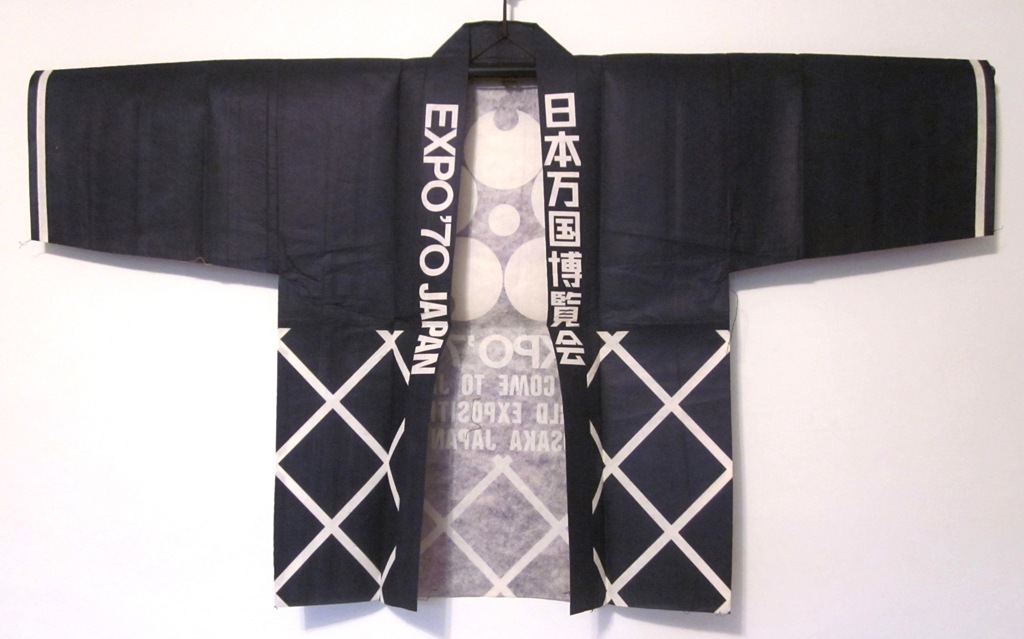
Happi
Polyester felt (?)

The happi, which identifies members of the same group, has a very long tradition, which has here been updated for modern times. The color, the large central crest, and design at the hem echo the standard happi, but for the 1970 Expo, old fashioned cotton has been replaced with new fashioned synthetic fibers.

This happi looks as though it was never worn (perhaps because it says well come). The stiffness, sheen, texture and atypical reaction to bending and creasing may have been attractive novelty features in 1970. In the close-up below, the fibers have no warps and wefts, but appear randomly placed, as if they were felted. Felting works through friction, shrinkage and the interlocking of fiber scales. Since this material is synthetic, the ‘felting’ process is more likely the result of heat and pressure.

The individual fibers are harder to make out on the reverse, which received no dye at all. (Double click to enlarge.)

Here is a view of the edge of the material.

Just as kimono were ordered from design books, so were happi. This book is dated 1950, only twenty years before Expo was held.

Woman’s yukata (casual summer kimono)
Cotton
Several types of shibori

Most yukata have blue and white as their two base colors, but occasionally other colors are used.

This lattice design is called kagome, and is often used in basket weaving. The flowers are peonies.

The woodblock print below, by Sadahide, shows kagome weave used in gabions along a riverbank. (Photo thanks to http://www.printsofjapan.com.)

Wedding furisode uchikake (overkimono with long sleeves)
Rinzu (figured satin)
Embroidered, stenciled, couching

This wedding gown was probably part of a matched set of three robes. The uchikake is the topmost layer, worn open. Most likely the other two robes were red and black, customary for the times. The workmanship, materials and design indicate that they were worn by a woman whose family enjoyed great wealth and status.

This uchikake abounds with auspicious and wedding symbolism. There are the traditional crane and tortoise, symbols of long life, the pair of cranes, an allusion to the married couple, and the pine, plum and bamboo, or shochikubai, the so-called ‘three friends of the cold’, symbols of virtue.

The photo above shows a close-up of one of the cranes. What appear to be dots on the wing are actually needle holes. The crane’s wing was black, and the silk threads, mordanted with iron, have disintegrated with time. Beside the crane is a bamboo tree of stenciled shibori. While shibori was more expensive than stenciled shibori, the flat look of stenciled shibori was a style in its own right.

In the photo above, the design woven into the soft, delicate figured satin can be made out. The tasseled faceted box traditionally holds pairs of clam shells. Each matching pair of clam shells is painted on the inside with matching miniature designs. The clam shells are scattered on the floor, and the object of the game is to match the clam shells. Since no two clam shells are exactly alike, they will only align with their original partner, making the clam shell game an apt metaphor for the newly married couple.

Kimono
Silk, cotton (lining)
Stenciled warps and wefts (meisen)

Because of the emphasis on perspective and shading, this kimono seems to be making references to surrealism, and specifically to Giorgio de Chirico, who is known for his many paintings of the Piazza d’Italia. Below is The Mystery and Melancholy of a Street, dated 1914.

The person who sewed this kimono made the decision to orient the material for the sleeves in the same direction, but the two body panels are in opposing directions.

In the painting, there are shadows within the shadows. The textile designer seems to have copied that, using shaded vertical lines to accomplish the effect.

This material is generally referred to as meisen. Meisen is often characterized by stiff, almost starchy silk, which was more affordable than higher grades of silk. It is also characterized by the direct stenciling of warps and/or wefts with chemical dyes, which were then woven to produce the slightly fuzzy-edged designs. Meisen was manufactured by several companies, and the company’s logo was stamped at the end of the bolt of cloth. In the photograph below, part of the company’s stamp has accidentally been included at the base of one of the long sleeves.

Woman’s hair ornament
Silk, wadding, paper
Shibori

This small hair ornament fits in the palm of the hand. The paper backing (see below) helps it keep its shape, and the cords secure it around a section of hair.

The shibori puckers are very regular and no stitch holes are visible, raising questions about the technique.

Below is an old hand-tinted image of women’s hairstyles. The woman at the extreme left has a shibori ornament in her hair. (Photo from Okinawa Soba.)

This untinted image shows another way to use shibori as a hair ornament.

Stencil
Paper, persimmon tannin, silk threads
Hand cut

This stencil depicts an ox cart wheel, a water wheel and a wheel of arrows, on a background of hare’s foot ferns.

Despite the exacting workmanship, this stencil is no longer usable – the fine spokes on the ox cart wheel and the water wheel, as well as the feathers of the arrows, have been damaged with repeated use.

Notice the fine netting, sandwiched in between two layers of the stencil, that help secure the finely cut paper and allow for some very delicate design work.

Design a site like this with WordPress.com
Get started