Boy’s padded kimono
Silk, waste silk padding, cotton lining
Stenciled wefts (meisen)

This kimono is for an infant. Only one panel wide, it is referred to as a ‘hitotsumi’ (literally, single width). It has several traditional patterns, including the zigzagging matsukawabishi (pine bark lozenge), scattered pine branches, sailing boats in currents and roundels.

Hitoe (unlined kimono)
Silk (?), supplementary metallic threads
Stenciled warps

Morning glories were a popular theme in kimono design in the early twentieth century, and fans were an integral part of life in the hot Japanese summer. These morning glories, while cartoonish, are close to their actual shape, so one has to look twice to see that they are actually large fans on a background of smaller, solid blue fans.

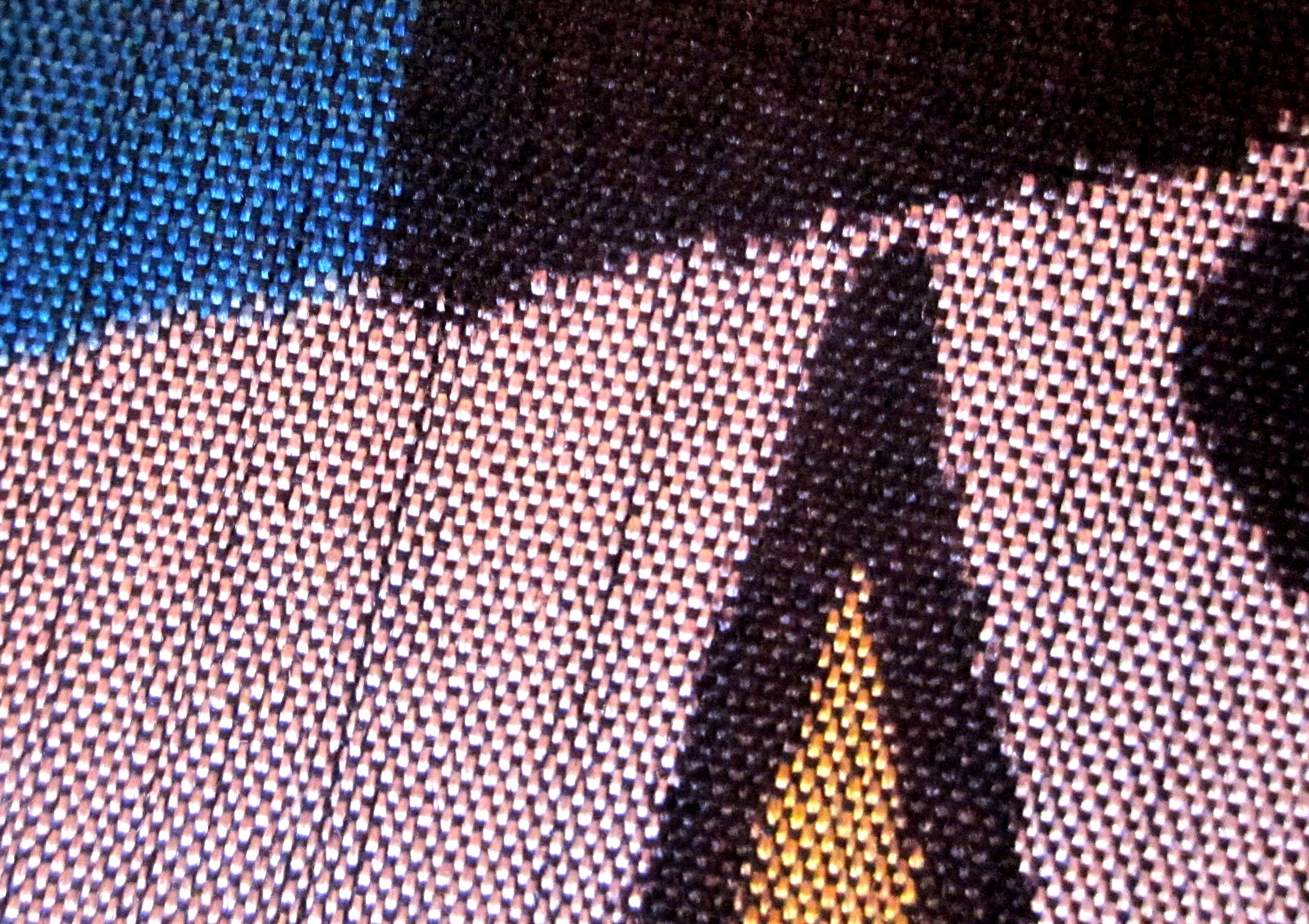
In this hitoe, only the warps have been stenciled. All the weft threads are black.

The supplementary metallic thread has its own points of interest. The longer exposed thread (below, photographed on the inside of the hitoe) has a core of green silk filaments, and is wrapped in a metallic thread which is green on its underside. The shorter exposed thread below it, which turns two corners, has a core of blue silk filaments, and the paper appears to be undyed on its underside. Elsewhere on the hitoe, there is metallic paper with a red underside. All of these serve to give the hitoe an extra hint of color as the light changes.

Kimono
Silk, cotton (lining)
Stenciled warps and wefts (meisen)

The erratic colored ribbons that rhythmically peak and plunge along straight lines across this kimono design echo the waves that blip across the horizontal axes of oscilloscopes, which were invented in the early 20th century, but came into widespread use following World War II.

In the first photograph, it is clear that whoever sewed the panels together made the conscious decision to alternate the dark and light patterns at the center seam. Either way would probably have created an interesting effect.  The large waves and the small waves both move almost without interruption across the center seam.  The juxtaposition of two alternating color blocks (dangawari) is a time-honored Japanese textile tradition, so this kimono combines a bit of the old and a bit of the new.

Kimono
Silk (tsumugi [pongee])
Stenciled and hand colored

This kimono depicts a number of chaire, or tea caddies, nestled in their shifuku, or pouches. It is interesting that a kimono focusing on tea is made of tsumugi silk. Revered Momoyama period tea master Sen no Rikyu changed tea from a very luxurious ceremony to a very minimalist event. For this reason, he favored tsumugi, which lacks the luster and smooth flat texture of silk, and appears cottony, rustic, and humble.

The ground color of the kimono itself is tea colored, continuing the allusion. Tea, which originated in China, was initially highly sought after and very expensive. It was stored in ceramic jars, and the jars were kept in pouches of expensive material, in keeping with the tea’s value. The knots atop the pouches are not random. There are specific ways to tie the cords.

This kimono appears to have been stenciled, but the individual colors of the pouches appear to have been brushed in individually. Below are three separate repeats of the same pouch. All are nearly identical, but not quite, which would reflect the hand painting.

In his book Nihon no Dento Shikisai (Traditional Colors of Japan, published by Kyoto Shoin), Seiki Nagasaki identifies over forty shades of color ending in the word -cha (tea), such as yanagicha (willow tea), uguisucha (nightingale tea), ebicha (shrimp tea), and rikyu cha (named after Sen no Rikyu, although no evidence links the color to the tea master). These colors are generally shades of green, brown, yellow and gray, but can be other colors too (pink, for example) if they contain chalky, smoky, cloudy or opaque qualities. Following Nihon no Dento Shikisai, the kimono shown here comes closest to kuwacha (literally mulberry tea, translated as the color maize) and kimirucha (literally yellow sea pine tea, translated as seaweed yellow).

Woman’s bag
Cotton (homespun), silk velvet, paper (? – base lining)
Stenciled (cotton)

The exterior of this bag is made of what the Japanese call sarasa, or printed cotton. Originally, sarasa was imported from such places as India and Indonesia, which had a very highly developed export cotton market. In time, however, the Japanese were able to make excellent copies of sarasa domestically.

The interior of the bag is lined in silk velvet, most of which has worn away. Both the sarasa and the velvet were considered luxury materials. The two elegantly carved toggles are most likely made of bone (antler?), rather than elephant ivory. Around the center of the bag is a clear horizontal line where the stencil ended and began again.

This bag may have been made by the wearer. The eyelets seem to have been made simply by creating holes in the fabric, which have not been reinforced.

The bag also appears to have been worn with no edging around the base to finish it. In the photo below, where the side has been sewn to the base, the original velvet pile can be seen clearly. The base probably stays flat with the help of stiff paper between the inner and outer layers.

Apron (maegake)
Cotton, silk

This apron has seen so much wear that it might be called “boro”, or rag. Some of the material is very old (possibly mid-late 1800s), and some is of more recent vintage (pre-war).

Fourteen separate materials make up this apron. The largest is a remnant of beautiful stencil work; one of the smallest pieces is double kasuri. The photograph below shows the stencil. Dyed identically on both sides in two shades of indigo, this would have been an expensive piece when new. The popular design combines a goose head with the V in which geese travel, according to John Dower in The Elements of Japanese Design. With the added flourish of the circle at the base, the design is called the ‘knotted goose’.

The large dark patch on the back of the apron is shown below in close up. This very soft cotton patch appears to be monochrome, but on closer inspection, there are small glints of light among the dark threads. When magnified, it can be seen that the light comes from the sparing insertion of a bit of luxury in the form of fine silk threads.

The apron strings are made of two completely different materials.

In the Hiroshige print below, The Famous Teahouse at Mariko, a woman can be seen serving guests while wearing an apron to prevent damage to her kimono.

Panel
Cotton
Double kasuri

This is an odd piece of kasuri, partly because the pictorial designs are crudely drawn and executed, and partly because the designs – an umbrella and a boat with its anchor – are not normally paired. Perhaps there is a subtle visual pun, or a name reference.

Only the well cribs are double kasuri. The umbrellas and boats are rendered in weft kasuri. In the well cribs, where the resisted white warps meet the resisted white wefts, the material is a bright white. Since the umbrellas and boats are only weft kasuri, the white is more muted since it is less concentrated.

Although this panel contains unbrellas and boats, since it is weft kasuri the weaver could change her mind, if she wished, and insert a different weft design at this point in the cloth. The wefts for the well cribs must be inserted at a specific location for the design to match with the warps, but the weft-only designs are actually up to the weaver as she progresses up the length of the cloth.

Kimono
Silk
Stenciled warps and wefts (meisen)

This modern art kimono might have borrowed its asterisk motif from Joan Miro. The same asterisk, when inserted in a roundel, bears a strong resemblance to a sliced Japanese lotus root.

For a short period, a number of leaders of the abstract art movement, including de Kooning, Pollock, Krasner and Bultman, painted works characterized by black canvases punctuated with bold abstract forms in red and white much like those seen here.

Lotus root photograph borrowed from Foodhoe.blogspot.com.

Panel fragment (from futon?)
Cotton (homespun)
Rice paste resist (tsutsugaki), stenciling

Underlying themes of evanescence, metamorphosis and beauty all combined to make the butterfly immensely popular in family crests of the military class. This particular crest is associated with the Taira clan, a very old and distinguished military family. For more on the Taira clan, click here.

This panel is a fragment of a larger piece, but probably only consisted of repeats of the white butterfly in green outlines and the green butterfly in white outlines. The use of the two contrasting colors makes maximum use of a minimum of materials.

Most likely this color was achieved by first dyeing the textile yellow (with turmeric?), and then overdyeing with indigo.

Design a site like this with WordPress.com
Get started